

What We Are Tracking
As the World Watches Us

Our Tahltan Leadership continues to state, “the world is watching us.” While this phrase is being extolled to sell membership on why we should vote “yes” on the Eskay Creek Impact Benefit Agreement (IBA) — we wanted to take the time to offer a broader perspective as to why there are so many eyes on our nation, territory and this IBA process.
Since the start of 2024, many journalists, and news outlets in Canada and the U.S. have been reporting on how the Tahltan Central Government has been handling the negotiations with Eskay Creek and our relationships with our neighbors, who have been and will continue to be impacted by projects operating in Tahltan territory. Now before you shout, “but the Alaskan’s are over-fishing” as you’ve probably heard all of our leadership say by now, please pause and take a deep breath.
This is not a tit for tat situation. Does over-fishing warrant a complete disregard for development that has and could continue to contaminate all of our waterways? Don’t we all need access to clean water? Don’t all fish need access to livable ecosystems, and how many other animals depend on the fish and clean water? Are we in alignment with our Tahltan values and laws when we say that it is okay to create harm to those who live downstream to us?
We think not, especially after seeing this video and clip from Salmon Beyond Borders that was shared with us during last week’s presentation.
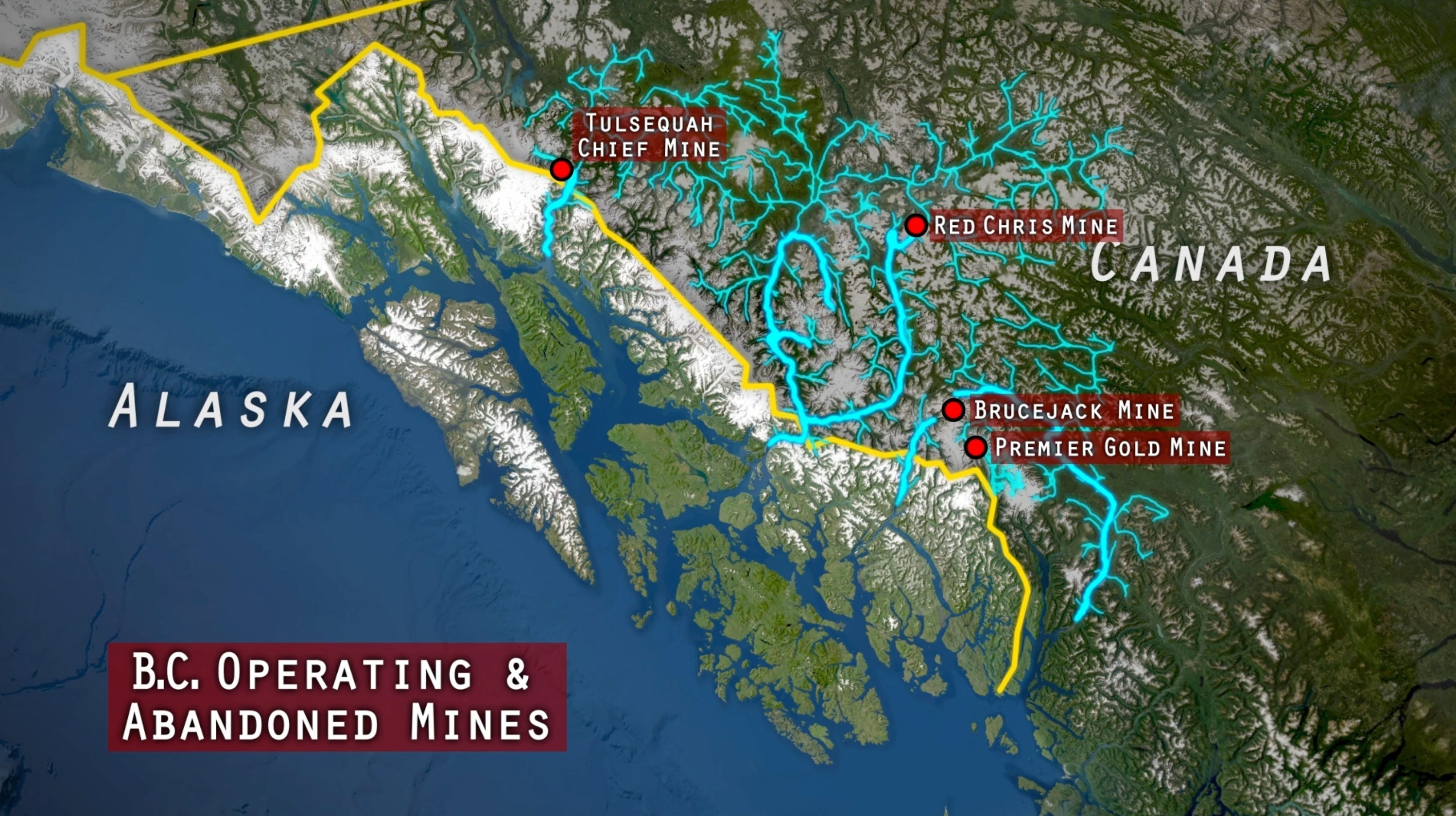
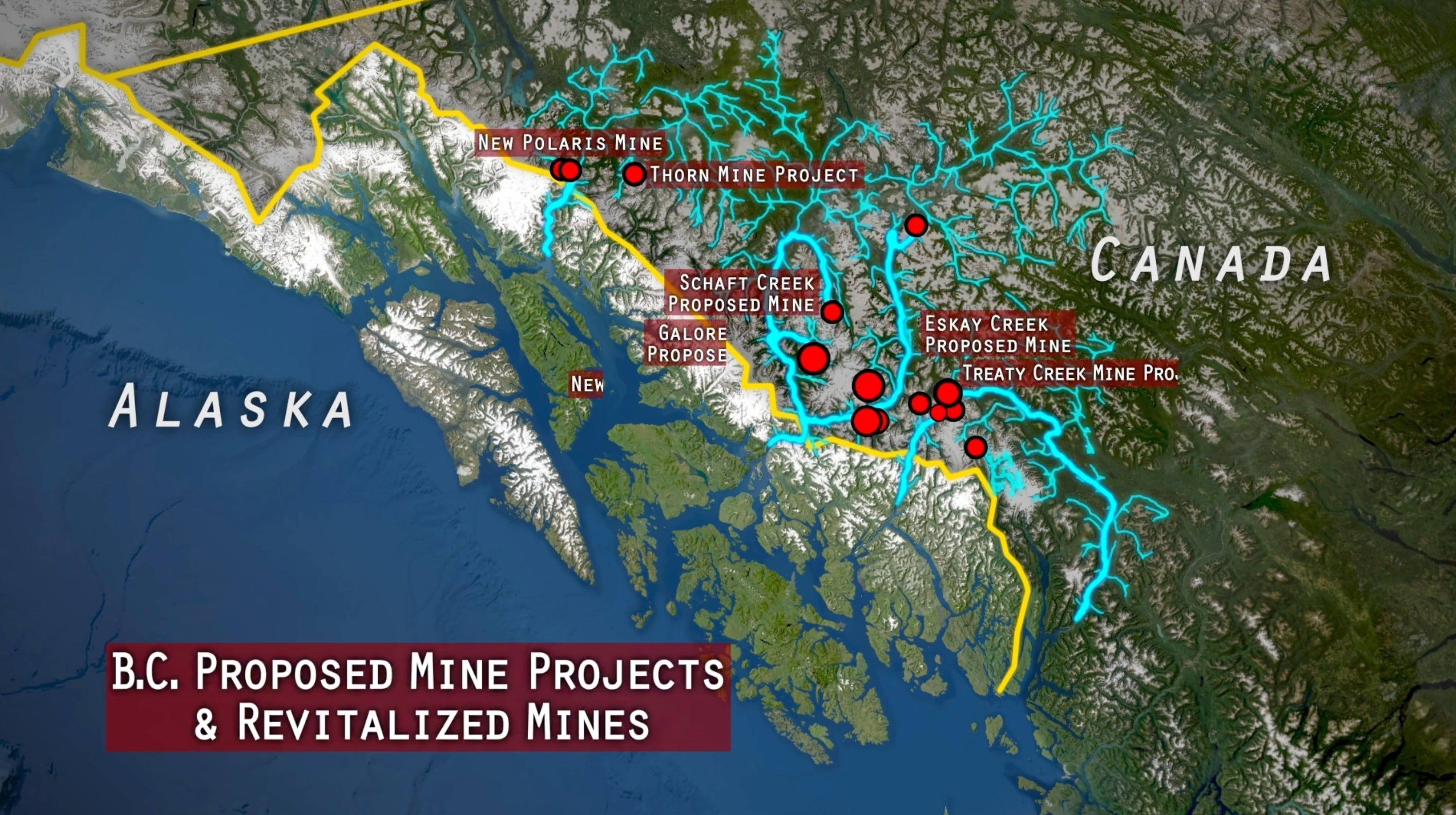
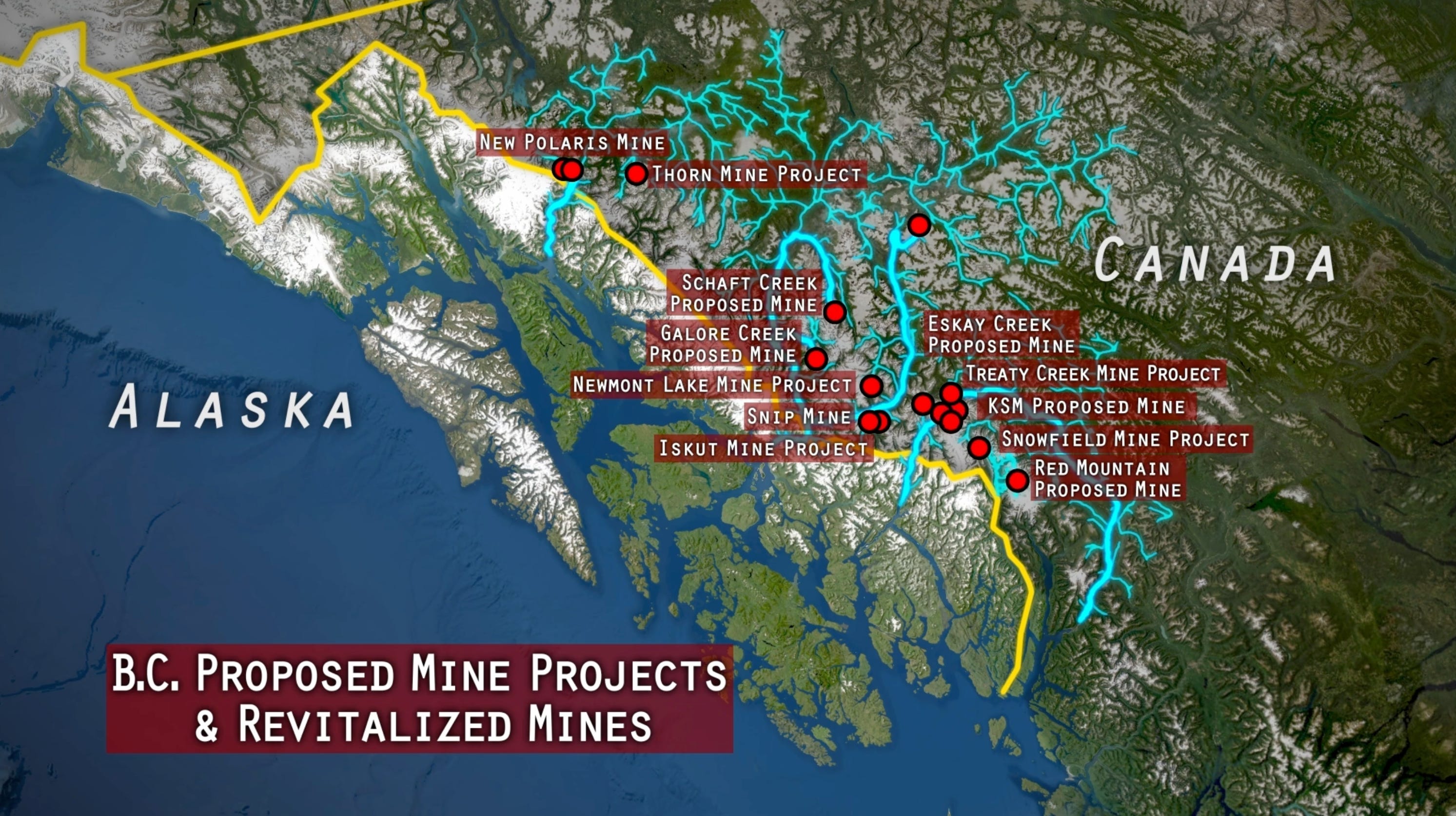
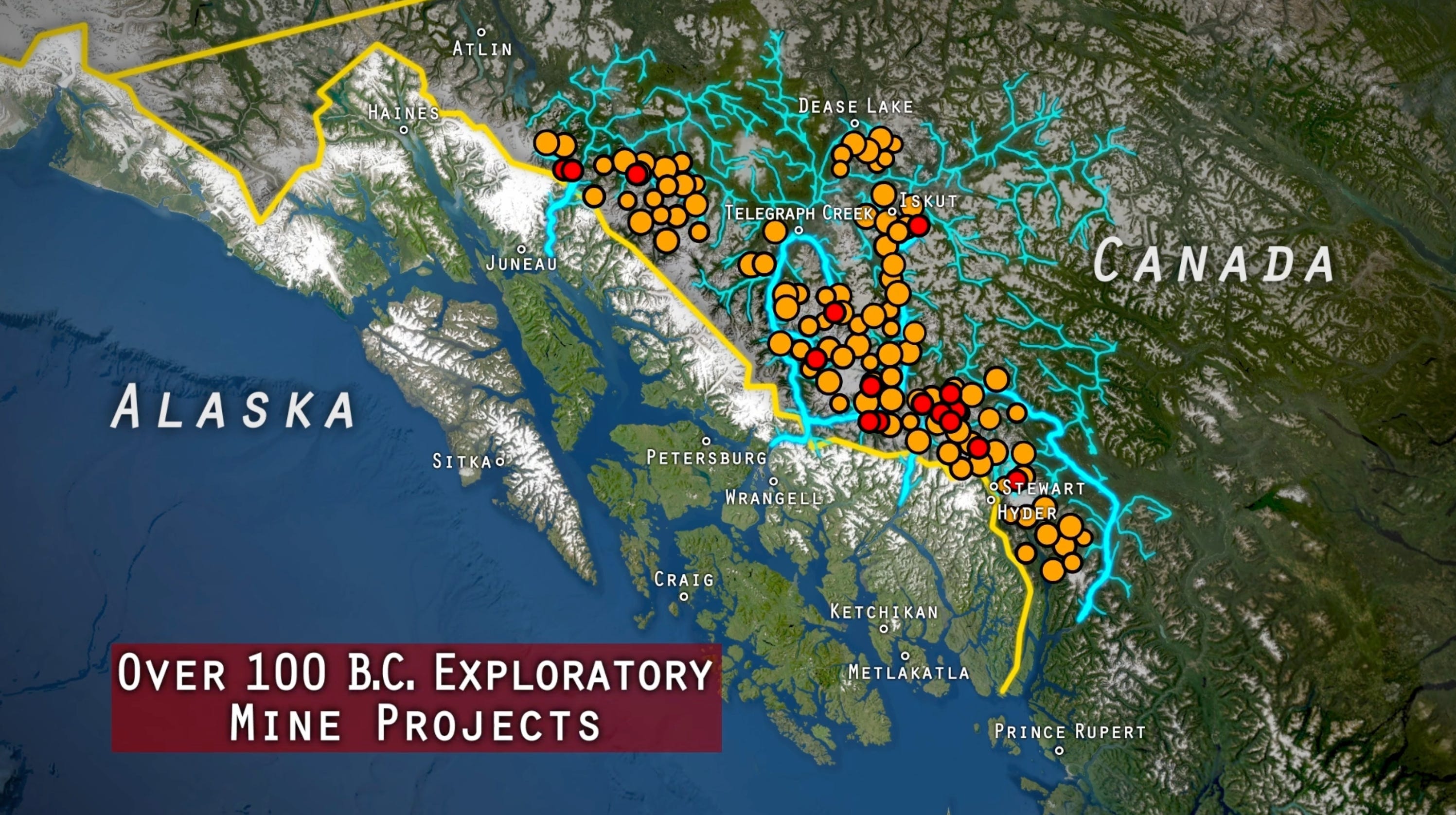
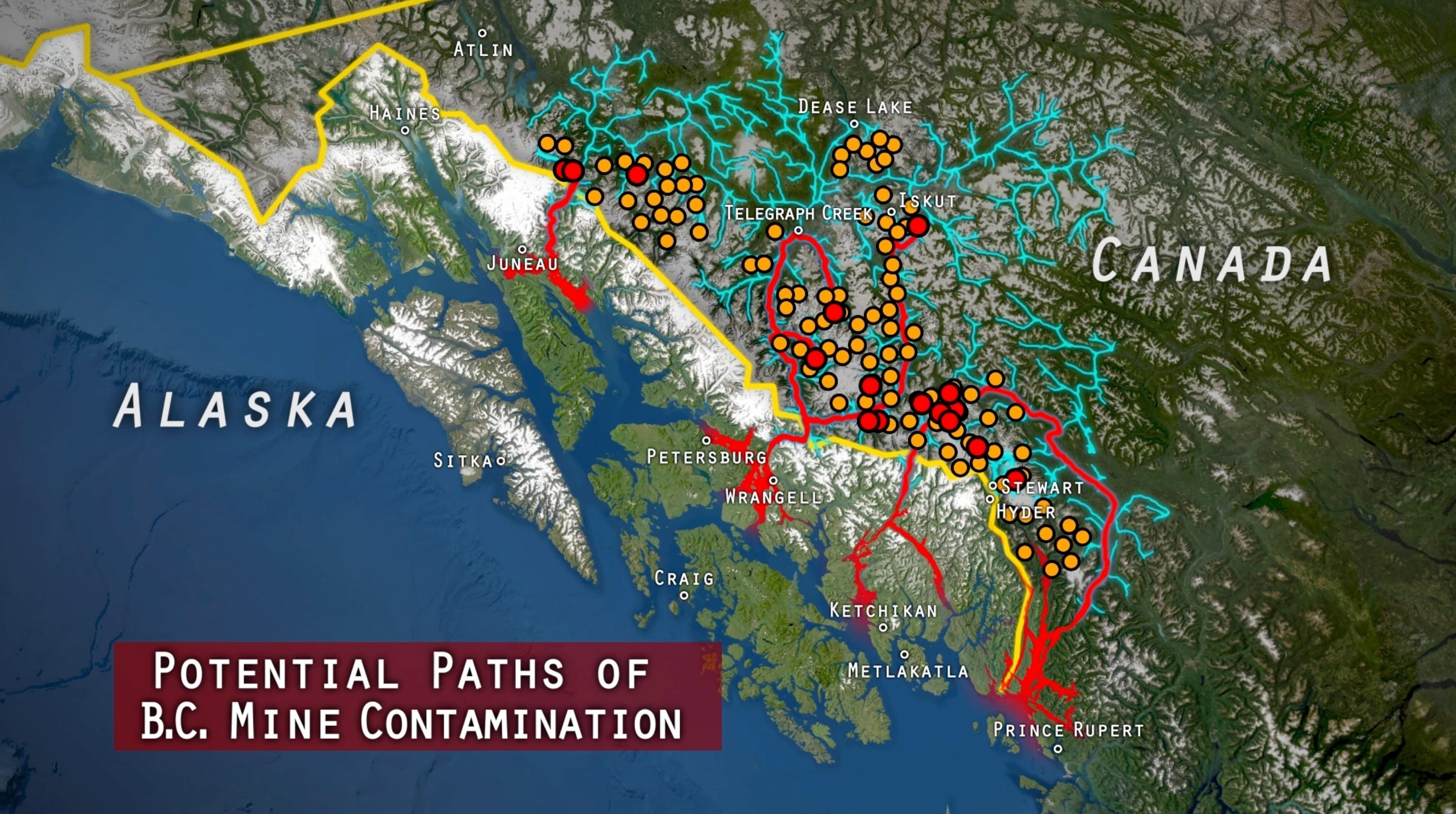
Screenshots above sourced from SalmonStateAK video, British Columbia mining activity in transboundary waters
What also becomes glaringly obvious after watching this short video is that the Eskay Creek Revitalization project is the tip of what is coming our way. While we currently have 4 operating and abandoned mines that impact transboundary waters with Alaska, there are over 100 B.C. exploratory mine projects in the region. This level of outside interests in our territory can also be understood by reading the Association for Mineral Explorations (AME) Interest Statement on the Northwest Land Use Planning Process, published October 16th, 2025. It includes a specific statement on our territory and reads,
“The Tahltan sensitive area contains the largest total spend of the areas at $17,452,615.28 with 113 claims. This region contains many active exploration projects that if expropriated would send a negative message. Additionally, the Hat region of the territory contains both active exploration projects on mineral tenures and high mineral potential. We would like to warn you about the significance of what shutting down this region for exploration would mean for our industry. Along with gold, projects in this region contain proven reserves of critical minerals like copper, scandium, cobalt.”
All of this leads us to wonder, like many other Tahltan members have, why the Tahltan Central Government does not have a comprehensive plan in place for mining. While we continue to be told that we must vote “yes” on the Eskay Creek IBA, the reality is that there are many more projects on the horizon, and that how we approach mining in our territory should be handled strategically.
Instead, we are being offered a piecemeal approach, in which we are continually told, “this is consent based”, “the best deal ever!” and led to believe that once we have more money, all of our social issues will go away. To which we cannot help but note that throwing money at a problem does not fix it. Problems, especially society-wide, multi-generational ones that have become systemic, require concerted, long form and deeply cohesive leadership.
By withholding the larger picture of what’s to come, and reinforcing an isolationist stance when it comes to our borders and our relationships with neighbors, it also begins to look to the outside world like Tahltans are bullies. What else do you call a person or a people who uphold their own self interest at the cost of others? Is this really how we want to be known by those we have always traded with, worked with and even intermarried with? We seem quick to forget that many of our neighbors include close and extended family members, and that we share some of the same ancestors.
By not being shown the larger picture, we are also failing to understand that yes, there are many eyes watching to see how compliant we are to outside interests. How we as a nation handle negotiating and voting on Eskay Creek sends a message to entities like AME and companies who are beginning to line up behind Skeena Resources. To which we ask, what do we want the world to know about what it means to be Tahltan?
Media Coverage We are Tracking
BIV: Tahltan members raise alarm over $10K offers before critical mine vote, Stefan Labbé, Nov 27, 2025
“In the months leading up to the vote, several Tahltan members have raised concerns that their own government is touting the benefits of the mine without disclosing the full scope of the financial and environmental risks that come with it. “
The nation’s leadership stoked some members’ concerns even further when, on Nov. 20, it said it had negotiated a $40-million “upfront payment” that would be distributed in $10,000 payments to eligible individuals.”
The Tyee: One Indigenous Community’s Mining Windfall Is Another’s Worry, Vince Beiser, 24 Nov 2025
“But as the rush for critical metals turbocharges demand for copper, that same mine, and several others proposed for Tahltan territory, might pose serious risks for other Indigenous groups across the border in Alaska.
It’s an example of how, even in places where Indigenous peoples have won a degree of power, the costs and the rewards of the critical metals rush still aren’t being spread around equally.”
BIV: Alaskan tribes sue B.C. over fast-tracked gold mine, Stefan Labbé, Nov 21, 2025
“The petition to the court claims the Unuk River is a vital part of the Alaskan tribes’ traditional territory, and historically supported robust runs of eulachon (candlefish) and all five species of salmon, sustaining their communities for generations.
They contend that the previous operation of the Eskay Creek mine led to water pollution and the decimation of these fisheries starting in the mid-1990s, resulting in a eulachon fishing moratorium by 2006.”
Northern Journal: Who will benefit from melting glaciers?, Max Graham, May 22, 2025
“Those are elements, like copper, that Canadian officials have deemed essential for national security and renewable energy. Some Alaskans, including the state’s Republican U.S. senators have worried that funding for Canadian mines could also come from the U.S. government, potentially boosting mining upstream from Alaska and endangering the state’s fishing industry. The Biden administration directed tens of millions of dollars to mineral projects in Canada, also in the name of national security and clean energy as it considered Canada akin to a domestic source.”
Northern Journal: Above the Stikine River, the Canadian government is boosting a huge mining project you’ve probably never heard of, Max Graham, Oct 21, 2024
“Multiple rivers in the region span the U.S.-Canada border, and tribal governments and environmental groups on Alaska’s coast fear that new mines in northwest B.C. could pollute those rivers and harm lucrative and culturally vital fisheries. Concerns mounted over the summer after a cyanide spill at a major Canadian gold mine in the watershed of the Yukon River, Alaska’s biggest transboundary waterway.”
KRBD: Southeast tribes seek a pause on Eskay Creek Mine near B.C. border, Angela Denning, Aug 20, 2024
“Earthjustice is looking to a Washington D.C. based human rights organization to help out. They submitted a 47-page request to the Inter-American Commission on Human Rights to pause the Eskay mine. The request calls the mine’s impacts “serious” and “a foreseeable, imminent, and significant threat.””
BIV: Group of Alaska Tribes demands pause on B.C. mining project upstream of ‘ecological hotspot’, Sydney Lobe, Aug 12, 2024
“The revitalization of the Eskay Creek mine is just one example of many proposed B.C. mining projects in the headwaters of the Unuk, Stikine and Taku rivers, which could impact the member tribes of the SEITC. In 2020, the SEITC filed an international human rights complaint against the Government of Canada for the human rights violations B.C. mines pose to the tribes. The complaint is currently in its briefing phase.”
CBC: Alaskan tribes seek historic legal recognition from B.C. gov’t for review of mining project, Caitrin Pilkington, February 7, 2024
“”These international borders transact a watershed,” said Guy Archibald, executive director of the SEITC. “Nothing else in nature respects those lines. Not the salmon, the water, the wildlife, even the people. The watershed needs to be managed as an entire unit, not cut in half and placed under different management practices.”“